
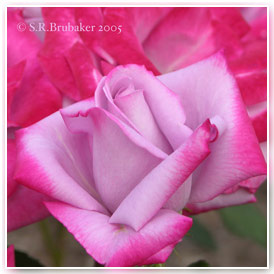
Fragrance can be one of the most alluring aspects of the rose. When we see a rose we instinctively lift it and smell it. The rewards of this behavior can be tremendous. Or it can be disappointing. One can look at faboulous, huge, perfect photos of roses in books or prints, or on line, for seconds, minutes or hours, and none of it compares to finding a good smelling rose.
There are lots of strategies to finding good smelling roses:
Decide which is more important, a long lasting cut rose or a good smelling one. There is another rule that says that thin rose petals release fragrance readily, thus roses with thin petals seem more fragrant. The consequence of thin petals is that the flower does not last well when cut. For some time between 1945 when Peace took the world by storm and 1985 when a handful of David Austin's roses got rave reviews, the conventional wisdom, especially in America, was that photos sold roses. Period. This meant fragrance was irrellevant. As a consequence, roses had fragrance as a matter of accident rather than as a matter of design. The fragrant rose began to look like a thing of distant memory.
---
Today we see a resurgence of attention to fragrance among rose breeders. Carruth, for example, has managed to leverage a long tradition at Weeks Roses of working with fragrance as a part of the breeding equation. For some time between the fifties and the seventies their most notable introductions were as noteworthy for their noses as for their shapes, sizes, colors, and habits. Today, roses such as Neptune and Memorial Day are large, well formed, healthy and vigorous roses that boast plenty of delicious fragrance. Breeders at other large rose institutions are introducing fragrant floribundas at a pace uneard of two decades ago.
Each rose attribute goes through periods in which it gets relatively more or less attention. During the 40 'dark years' for fragrance, much work focused on color and much headway was made in improving the color pallet of the rose. It seems a bit unlikely that fragrance will ever get the same level of undivided attention, but fortunately the rose will continue to smell good so long as there are gardeners who insist that:
A rose by any name should smell as sweet.